
Endorsement of Health benefits of ‘Oryzanol’ by National Institute of Nutrition, Hyderabad

What is Rice Bran Oil?

Rice bran oil is the oil extracted from the hard outer brown layer of rice after chaff (rice husk). It is notable for its high smoke point of 232 °C (450 °F) and its mild flavour, making it suitable for high-temperature cooking methods such as stir frying and deep frying. This oil internationally is recognized as health oil and in Japan called Heart Oil. This oil is the only cooking medium which has an ideal SFA/MUFA/PUFA and Essential Fatty Acid ratio which is closer to the recommended levels of WHO. A number of scientific studies have confirmed that using Rice Bran Oil as a cooking medium could significantly reduce the bad cholesterol without adversely affecting the good cholesterol due to presence of a unique component in this oil known as “Oryzanol” which is not found in any other vegetable oil.

National Institute of Nutrition in its Dietary guidelines has mentioned that Oryzanol found in Rice Bran Oil is helpful in reducing:

  • Cholesterol
  • Oxidative damage due to ageing
  • Inflammation which occur in chronic diseases.

In response to a RTI, ref no. D/RTI/2009/039, the National Institute of Nutrition has confirmed several health benefits of Oryzanol referring to various Scientific Studies, which are as follows:

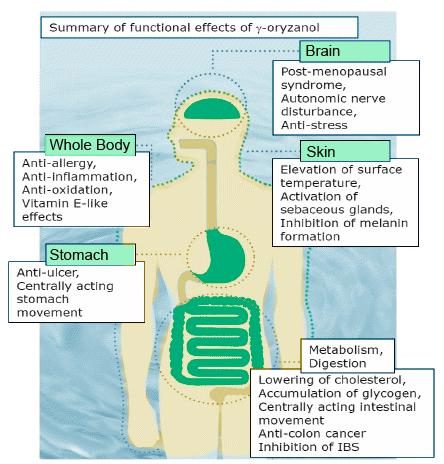
  • One of the most important properties of the oryzanol is its cholesterol lowering property. There are several studies in human and animals showing that the oryzanol content of the Rice Bran Oil has the property of lowering total cholesterol, LDL cholesterol and increasing HDL cholesterol. In addition, oryzanol also decrease plasma triglyceride levels.
  • Oryzanol is also a potent antioxidant. The antioxidant activity of oryzanol has been shown to be 10 times higher than that of tocopherols. High content of oryzanol provides oxidative stability to rice bran oil and improve its shelf life.
  • Oryzanol has a protective role in ultraviolet light induced lipid peroxidation and hence it is used as sunscreen agent in cosmetics.


Why only Rice Bran Oil?

  • Rice Bran Oil has the best balance of saturated, monounsaturated and polyunsaturated fats as recommended by such organizations as the American Heart Association and the World Health Organization. It’s the oil of choice for improving serum cholesterol levels and preventing cardiovascular diseases.
  • It has Tocopherol (Vitamin E), an antioxidant which reduces the incidence of stroke, reduces coronary blockage and helps in balancing the nervous system. Tocotrienols inhibit platelet aggregation and growth of human breast cancer cell. It has anti thrombotic and anti cancer properties.
  • The lipoic acid in Rice Bran stabilises blood sugar levels and reduces the damage in body caused by excess sugar.
  • Rice bran supplements could lower blood pressure.
  • It has squalene, an antioxidant present in Rice Bran which improves skin tone and delays wrinkle formation. It also acts as an anti dandruff and anti itching agent.
  • It has 4 hydroxy 3 methoxycinnamic acid which stimulates hormonal secretion and rejuvenates health.
    It contains IP6, a chelating and antioxidant agent has beneficial bio-active functions such as the prevention of urinary calculi, the improvement of immune system and anti cancer action.
  • It is a potent mutagen and even after heating to higher temperatures of 180 c, does not exhibit mutagenic activity.
  • The viscosity of this oil is very light and the flavor delicate. Foods cooked with Rice Bran Oil absorb up to 15-20% less oil! Less oil absorbed results in reduced calories, better, lighter tasting food and enhanced flavor and palatability. Less oil absorbed also makes it more economical.
  • Rice Bran Oil is hypoallergenic. For those who have intolerance to other cooking oils this is an excellent alternative.
  • Rice bran oil has a very high smoke (burn) point, making it perfect for deep frying, pan or stir frying and is a premium choice for the replacement of hydrogenated oil containing trans fat as this has Zero Trans fat.
  • Rice bran oil creates less polymers than other oils meaning better flavor and easier clean-up.
  • Health aspect of rice bran oil is not highlighted as much as it should have been done this is where the market is in terms of the total awareness, be it as a hypocholesterolenic, antiviral, antioxidant and anticancer effect, or even a scavenging effect of carcinogens. All these need to be highlighted.

Expert Views on active use of RBO

Dr. V. Parkash, Director, Central Food Technological Research Institute, Mysore

Rice bran oil, obtained from rice bran a byproduct of rice milling, is a unique edible oil with nutritionally desirable attributes compared to other edible oils, its fatty acids composition is nearer to that recommended by nutritionists ideal for edible purpose. It has cholesterol lowering property attributed to oryzanol, a minor constituent, present in the oil. It contains minute quantities of nutritionally valuable constituents, such as tocopherols, sterols squalene etc., which are important for promotion and maintenance of good health.

Dr. A.B. Afzalpurkar, Dy. Director, Indian Institute of Chemical Technology, Hyderabad

Rice bran oil enjoy the status of a health food from a cardiovascular view point and routine use of rice bran oil can be recommended as a sole cooking medium.
Dr. Parveen Chandra, MD, DM, Consultant Cardiologist, Escort Heart Institute & Research Centre, New Delhi

Rice Bran Oil will be the cooking medium of first choice and preference to bypass, bypass the dietary way.
Dr. Shashank R. Joshi, MD, DM, FICP, FICN, Endocrinologist, Lilavati Hospital, Mumbai

Rice Bran Oil has many health benefits which have been proved by world renowned institutions. These benefits will be discussed in the article in the next update.
 

Dietary Guidelines for Indians – A Manual by National Institute of Nutrition

Other Articles

Aluminum Foil: Health Risks Associated with its Usage

Information in the below article has been taken from online journal and research papers to provide an overlook on aluminum and its usage as per Irshaad of Huzurala TUS.   Abstract: Abundance of aluminum in earth’s crust results in high usage in daily life as well...

The Power of Families Eating Together

Université de Montréal doctoral student Marie-Josée Harbec and her supervisor, pyschoeducation professor Linda Pagani, made the finding after following a cohort of Quebec children born between 1997 and 1998. It's very hard to examine if the correlation between...

Health Benefits of Figs

Figs are seasonal fruits that are found in the western parts of Asia, but dried figs are available almost everywhere, at any point during the year. The fig tree is a member of mulberry family. The health benefits of figs come from the presence of minerals, vitamins...

Coffee Cultures and Consumption Throughout the World

For Americans the world coffee is synonymous. They are the largest consumers of coffee in the world estimating at around 400 million cups per day of 1.4 billion cups consumed every day. That is 40% of entire coffee consumed worldwide. However when it comes to most...

The Rebirth of Yemeni Coffee Industry

Coffee has been the key to Yemen’s future for the last decade. It has the ability to significantly reduce unemployment and poverty. It can generate funds to help rebuild the country and present a positive profile of Yemen on the world stage. Recent studies have...

Nutritious Seeds For Daily Consumptions

With the Dua and Raza of Dr. Syedna va Maulana Abul Jafarussadiq Aaliqadar Mufaddal Saifuddin (TUS), an awareness towards consumption of Flax seeds and Olives in regular diets has been created. In a fast paced life, it is essential to consume food that provides...

Health Benefits of Olives

Cardiovascular Benefits When free radicals oxidize cholesterol, blood vessels are damaged and fat builds up in arteries, possibly leading to a heart attack. The antioxidant nutrients in black olives impede this oxidation of cholesterol, thereby helping to prevent...

Health Benefits of Oryzanol in Rice Bran Oil

Following our first article, this article will discuss the benefits of Oryzanol the way it is discussed by world’s leading medical research centers. Helps in lowering cholesterol A scientific study conducted by Tufts University, Boston and University of Massachusetts...

Manuka Honey: Origin and Health Benefits

Manuka Honey: Origin Last article was based on Beech Honeydew Honey from New Zealand. However Beech Honeydew Honey is not the only famous honey originated from New Zealand. Manuka Honey also from New Zealand is also renowned worldwide. Manuka Honey is named for the...

Some Interesting Facts About Honeybees

It is the only insect that produces food eaten by man. Honey bees have 170 odorant receptors, compared with only 62 in fruit flies and 79 in mosquitoes. Their sense of smell is so precise that it could differentiate hundreds of different floral varieties and tell...

Beech Honeydew Honey: Origin and Health Benefits

As discussed in the previous article, in the light of Bayaan Mubarak of Huzur-e-Aala TUS delivered in Ashara Mubaraka 1437H Houston regarding popular honeys around the world. Last article comprised of the honey which is considered by many as the best honey in the...

Sidr Honey: Origin and Health Benefits

Al Dai Al Ajal Syedna Aali Qadr Mufaddal Saifuddin TUS during Ashara Mubaraka 1437H in Houston mentioned 6 world’s most famous honeys in his Waaz Mubarak. Sidr Honey of Wadi Daw’an from Yemen Manuka Honey from New Zealand Beech Honeydew from New Zealand Scottish Honey...

The Benefits of Red Lentils (Masoor Dal) for Fatness

Red lentils are seeds from legume plants that split in half after hulling. They cook relatively quickly and provide an important protein source, particularly in Indian food such as dal, a soup made with stock, spices and vegetables. A 1-cup serving of red lentils...

3 Health Benefits of Eating Meat

While the current trend is all about going vegan, the idea of eating meat (thanks to the horror stories about red meat) is rapidly diminishing. Most people consider vegetables and fruits to suffice when it comes their daily nutritional needs while also thinking that...

Health Benefits of Lemon

The health benefits of lemons are due to its many nourishing elements like vitamin C, vitamin B, phosphorous, proteins, and carbohydrates. Lemon is a fruit that contains Flavonoids, which are composites that contain antioxidant and cancer fighting properties. It helps...

Benefits Of Whole Grain

What is the difference between Whole Grains and Whole Wheat? We get asked regularly, "What is the difference between whole wheat and whole grain?" Our answer is another question: "What is the difference between a carrot and a vegetable?"We all know that all carrots...

Amazing Apple

Apples are among the most popular types of fruit in the world. They are the fruit of the apple tree (Malus domestica), originally from Central Asia, and are grown all over the world. Apples are high in fiber, vitamin C and various antioxidants. They are also very...

Deleterious Repercussions of Nutmeg (Jaifel)

What is Nutmeg? The nutmeg tree is a large evergreen native to the Moluccas (the Spice Islands) and is now cultivated in the West Indies. It produces two spices — mace and nutmeg. Nutmeg’s flavour and fragrance come from oil of myristica, containing myristicin, a...

Health Benefits of Rice

Regular rice is much maligned and is fast being dropped in favour of its unpolished avatar. But are the charges valid? Sports nutritionist Rujuta Diwekar separates the grain from the husk The Chinese eat rice with every meal, breakfast included, and the average...